martes, 22 de enero de 2019


lunes, 20 de agosto de 2018
Purchasing Habits in JANSAN
An Examination Of The End Users' Purchasing Habits
BY
Dan Weltin, Editor-In-Chief
Sanitary
Maintenance, Contracting Profits, and Facility Cleaning Decisions magazines
POSTED
ON: 8/20/2018
When it comes to product purchasing, end users have a
plethora of options. New innovations flood the marketplace each year,
potentially making traditional methods of cleaning obsolete. In addition,
big-box stores, e-tailers and even manufacturers all compete with distributors
for building service contractor and in-house cleaning manager business.
To help shed light on the 2018 purchasing landscape,
Sanitary Maintenance tapped into research conducted by its sister publications:
Facility Cleaning Decisions’ “Annual Reader Survey,” as well as the “2018
Report On The Building Service Contractor Market” from Contracting Profits and BSCAI.
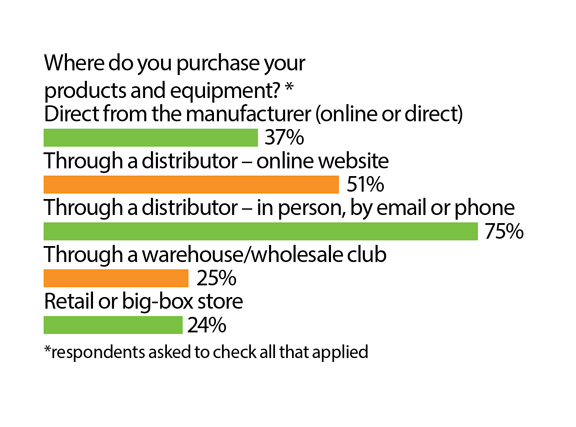
From this data, jan/san
distributors still remain the biggest source of products for both building
service contractors and in-house cleaning managers — and by a wide
margin.
Despite the threat of e-tailers like Amazon Business, end users
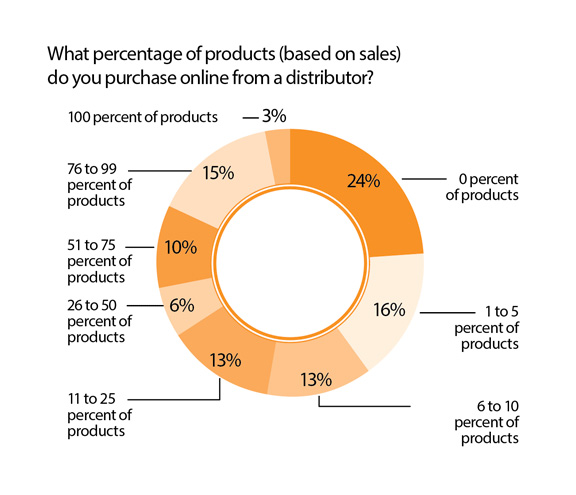
don’t want to purchase their products online. BSCs only buy 5 percent of their products from an e-tailer, and
a quarter of BSCs don’t buy any of their products online, even from their
distributors. In-house cleaning managers are more likely to use e-commerce than
their BSC peers, but this ordering method is still less common than an
in-person, phone or email order.
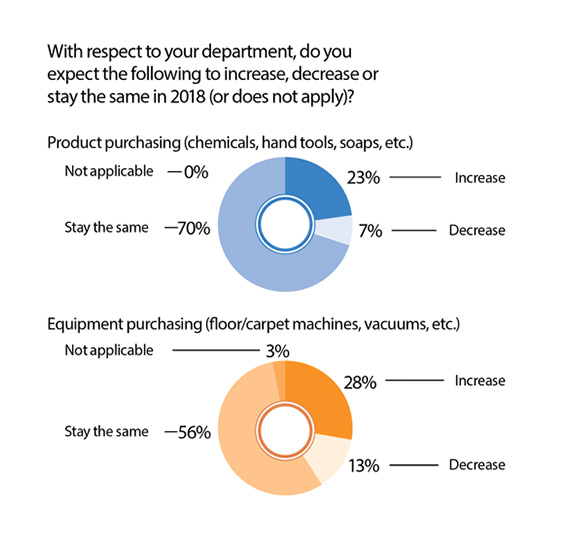
The number of in-house departments increasing their
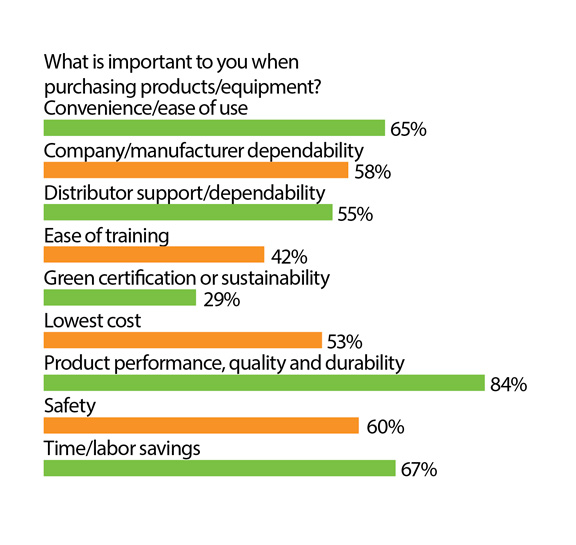
spending on products and equipment rose over 2017. When it comes to choosing
which products to buy and where to purchase them from, low prices still remain
less of a priority for in-house managers. Product performance, durability and
quality is once again the most important reason. Time and labor savings, ease of use, manufacturer dependability,
and distributor support are also more important than a cheap price.
Not surprisingly, frequently used products such as can
liners, brooms, mops and chemicals remain some of the most purchased
products.
However, nearly 20 percent
of BSCs are purchasing engineered water products, which is up from 13 percent in 2017. Despite the fact that more
contractors are embracing this technology, the amount of cleaners purchased
remains relatively unchanged.
Battery equipment is also becoming more common, evidenced
by the fact that half of building service contractors and in-house cleaning
departments are purchasing equipment batteries. And with more battery-powered
backpack vacuums entering the market, corded equipment could eventually be
phased out all together.



viernes, 16 de marzo de 2018
BRANDING
The Benefits Of Brand
Names
Selling Commercial Versions Of Consumer Brands
BY Heather Larson
What comes first, the product or the brand? It depends. In
1956, the permanent marker was invented, and then in 1964 along came the
Sharpie. Xerox quickly became the term used for any photocopying machine after
its introduction into the marketplace in 1959. More people ask for a Kleenex
than a tissue and Jell-o is synonymous with gelatin.
When it comes to products used in restrooms, many
recognizable consumer brands come in versions suitable for commercial cleaning.
Carrying these well-known brands can be advantageous to jan/san distributors.
When the decision-maker recognizes the brand, that can make
the buying decision easier, says Glenn Rasin, chemical specialist and lead
trainer for EBP Supply Solutions, Milford, Connecticut.
Many distributors offer a variety of name-brand options for
soap, hand sanitizer, cleaning chemicals, paper towels, toilet tissue and other
restroom products. Most consumers have either used these brands at home or are
at least aware of them. But will restroom patrons notice these brands in a
commercial setting?
“I think the general public doesn’t realize they’ve seen the
brand names, but subliminally, they see it and recognize it,” says Jack
Loughrey, account manager at Dalco Enterprises Inc., New Brighton, Minnesota.
“I would bet, if you were shown flashcards with the brand logos without the
type, just the color and shape, you could identify many, if not most of them.”
It’s the entire package of attributes — the logo, font,
design, colors, smell, price, etc. — that makes a product memorable. When
someone sees these famous-name products, it provides a sense of assurance, a
promise of sorts.
Sometimes a hint of this promise wafts through the scent or
when visualizing the color of the product. Either of these sensations creates a
level of comfort for the cleaning staff, says Rasin. They have familiarity with
this product. That comfort level comes from seeing literally decades of
commercials, ads and marketing efforts costing billions of dollars, he says.
Not only do these products breed familiarity, but they have
also been proven effective.
“These brands are the leaders for many reasons,” says
Loughrey. “Performance and reliability are two of the most important
[attributes] for those who work directly with the products.”
Custodial staff members appreciate when products perform as
advertised. They don’t like it when they have to work with inferior products
like paper towels that “tab” leaving bits of paper all over the floor, leaky
soap dispensers or paper towel dispensers that jam, says Loughrey. It means
extra work for them.
A company’s brand name is one of its key assets so it has to
protect product quality. If something goes wrong, a company has a great deal to
lose. For example, Takata airbags are still being recalled. These airbags were
installed in millions of vehicles, making this a costly experience for Takata,
not just in terms of dollars, but in publicity. Perhaps not surprisingly,
Takata filed for bankruptcy in 2017.
Because well-known manufacturers do work upfront to ensure
product quality, distributors shouldn’t have to worry if the product will
perform when pitching it to clients.
martes, 13 de marzo de 2018
Floor Care Tips
Floor Care Tips That Improve Perception Of Facilities
Contributed by Kaivac.
Floor care is often the centerpiece of commercial cleaning. Floors make the first impression on a building occupant when they walk into a facility,
Floor care is often the centerpiece of commercial cleaning. Floors make the first impression on a building occupant when they walk into a facility,
which
is why it is essential to make sure they are always properly cared for.
Leon Fields, business development manager for Kaivac, offers the following tips to making a lasting impression with floor care:
• Know the flooring. If you don’t know what kind of flooring you’re dealing with, you can damage it by using the wrong chemicals. If workers are unsure of the flooring type,
Leon Fields, business development manager for Kaivac, offers the following tips to making a lasting impression with floor care:
• Know the flooring. If you don’t know what kind of flooring you’re dealing with, you can damage it by using the wrong chemicals. If workers are unsure of the flooring type,
train
them to test chemical effectiveness in a inconspicuous area.
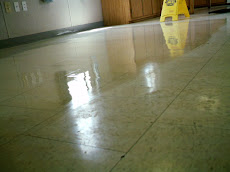
• A shiny floor is a safe floor. Building occupants often think a shiny floor is slippery. But cleaning professionals know that clean,
• A shiny floor is a safe floor. Building occupants often think a shiny floor is slippery. But cleaning professionals know that clean,
dirt-free
floors show the most shine and are less slippery floors with dirt on them.
• Proper matting can pick up a significant amount of dirt and debris as people enter the building. However,
• Proper matting can pick up a significant amount of dirt and debris as people enter the building. However,
it’s also important
to clean entry mats as they get saturated.
• High traffic areas need to be cleaned on a daily basis. While cleaners may be able to get away with spot cleaning less frequented areas,
• High traffic areas need to be cleaned on a daily basis. While cleaners may be able to get away with spot cleaning less frequented areas,
high
traffic areas are also high visibility.
• Stripping and restoring vinyl composition tile (VCT) is extremely labor intensive, which is probably because many cleaners don’t let their stripper sit long enough.
• Stripping and restoring vinyl composition tile (VCT) is extremely labor intensive, which is probably because many cleaners don’t let their stripper sit long enough.
Like
any chemical, floor stripper needs time to work.
• It is a common mistake for cleaners to use floor finish on floors that have grout. According to Fields, finishes wont adhere well to these floors because they are not flat.
• It is a common mistake for cleaners to use floor finish on floors that have grout. According to Fields, finishes wont adhere well to these floors because they are not flat.
Instead
of using finishes, he suggests keeping floors natural.
• Less is more when cleaning carpets. Cleaning chemicals are designed to grab dirt, and if excess chemical gets left in the carpet it will grab dirt from shoes,
• Less is more when cleaning carpets. Cleaning chemicals are designed to grab dirt, and if excess chemical gets left in the carpet it will grab dirt from shoes,
re-soiling
the carpet. Fields adds that most carpets can be cleaned with just hot water and
extraction.
martes, 27 de febrero de 2018
Managing airborne bugs
With so much attention paid to
cleaning and disinfecting surfaces and items like linens, infection
control-minded facilities often over- look the source of more than one-third of
nosocomial infections — the air. Long-established airborne precautions are rarely
used in long-term care facilities, according to the Agency for Healthcare
Research and Quality. Experts advise how to reverse that.
1.Understand the risks. Influenza
is by far the most prevalent airborne pathogen, and tuberculosis is the second
most serious, according to Gina Pugliese, RN, MS, FSHEA, vice president
emeritus of the Premier Safety Institute®. That's because the elderly are at
high risk of reactivation of an old, latent infection, and early symptoms are
not the usual cough and high fever.
Other common airborne infections
include Norovirus, C. diff, MRSA, pneumonia, respiratory syncytial virus (RSV),
parainfluenza, coronavirus, rhinoviruses, adenoviruses, disseminated shingles
and human metapneumovirus.
Another surprise: Many of these
also can spread in other ways.
“Illnesses transmitted through
the air occur when infectious agents spread via the airborne or droplet routes.
But contact with these germs can also spread these illnesses,” notes Deva Rea,
clinical science liaison for PDI.
2. Know your facility's
vulnerabilities. Airborne germs are opportunistic and seek weakness in places
like heating, venting, air-conditioning and water systems.
“Legionella pneumophila does
a great job of surviving in water and in ‘biofilms,' which can develop in water
pipes and other man-made devices,” notes Deb Patterson Burdsall, Ph.D., RN-BC,
CIC, FAPIC, an infection preventionist who also serves as faculty and author on
various projects related to long-term care for the Association for
Professionals in Infection Control and Epidemiology.
Ironically, the air itself is “a
central yet often overlooked transmission vector for dangerous pathogens,” says
Olivia Easly, marketing manager for Novaerus. And while airborne illnesses
typically find a path through coughing and sneezing, germs easily can be
aerosolized through such activities as bed making and vacuuming, she says.
Another vulnerability: group
activities. “These activities may increase communicable infectious disease
exposure and transmission,” Rea says. “The same is also true for occupational
and physical therapy activities.”
3. Housekeeping and maintenance
are vital to prevention. “Environmental service personnel are essential to
infection prevention. Regardless of the pathogen, good environmental cleaning
and disinfection are main prevention strategies,” Rea notes.
Facility maintenance workers are
critical when dealing with certain airborne illnesses such as TB by providing
monitoring of airborne isolation rooms under negative pressure, she adds.
Housekeepers should under- stand
that shaking soiled linens can aerosolize germs, advises Bill Brooks, North
American sales manager for UniMac®.
4. Preparing a rapid response to
an emerging infection is critical. Pugliese notes that staff vigilance can
prevent widespread infection. That's why it's important to understand the
sometimes puzzling early symptoms of an illness such as TB. Once detected, “the
usual principles of airborne isolation apply, which require negative pressure
ventilation and t-tested respirators, per OSHA,” she adds.
“If an outbreak of any airborne-
related illness occurs, it may be necessary to restrict admissions, visitors,
and cohort residents with the same illness,” Rea says.
5. Know how to protect your most
vulnerable residents. Immunocompromised residents can skew normal isolation
precautions.
"With some viral illnesses
such as influenza, RSV, norovirus and adenovirus, an immunocompromised patient
may shed the virus for longer periods of time,” observes Rea. “So it's
recommended to keep patients on isolation precautions for an extended
duration.”
6. It bears repeating: Caregivers
are often unwitting carriers and transmitters of airborne illnesses. That's why
training and adequate and plentiful personal protective equipment are
essential.
Basic, sound personal hygiene
practices such as regular hand washing and staying home when sick should be
enforced. It's also not too late to receive a u shot.
As noted, coughed or sneezed
aerosolized droplets aren't the only way pathogens reach the lungs. Germs on
contaminated surfaces and hands have an insidious way of reaching the mouths
and noses of patients. As Easly reminds, “the CDC and WHO have declared hand
disinfection as the most important standard measurement of hand hygiene in
healthcare facilities as it can lead — if correctly performed — to a drastic
reduction of nosocomial infections.”
Mistakes to avoid
1. Relying on consumer-grade air
filtration. The germ- laden air of nursing homes calls for industrial strength solutions.
Consider air sterilization systems that eradicate, not filter, germs.
2. Overlooking vulnerable areas
and practices. Biofilm in standing water is a breeding ground for illnesses.
Shaking soiled linens can actually aerosolize numerous pathogens.
3. Neglecting to have air
isolation precautions, including negative pressure rooms, available when a
nasty airborne infection is first spotted.
martes, 20 de febrero de 2018
SCRUBBING VS STRIPPING
Differentiating Between Stripping And Scrubbing Floors
"I get confused about stripping and scrubbing hard floors. What is the
difference?"
Good question since it very important that you understand the difference.
We can only briefly touch on the process in this article. You might want to
check on past articles that go into the actual steps for these two processes.
Both processes in it simplest form, utilize a low speed, rotary floor
machine that using the appropriate pad. The primary differences between the two
tasks are the chemicals and pads used that are intended to achieve different
results.
Stripping is utilizing a high pH (9.5 - 11) chemical mixed in water that
emulsifies the floor finish (also called wax) with the goal of its complete
removal before new seal/finish is applied. In most cases, a black or brown
stripping pad is used to aggressively remove any finish that was not
immediately emulsified by the chemical. A neutralizer (think mild acid) may be
necessary for bringing the floor pH close to 7 before floor finish or seal is
applied. Please do not make the mistake that some people make of mixing a
"little stripper" in their daily mop water since it damages the
finish and may require complete stripping before it would have been necessary
if the correct mop products were used.
Scrubbing is utilizing the same type floor machine but different chemicals
(think 7.5 - 8.5) that have a detergency with the goal of removing the top
soiled layer of finish without damaging the base coats. Floor techs have their
preferences but in most cases, a blue or green scrubbing pad is utilized to
safely remove the finish. After rinsing with water, the floor will be ready for
more finish. Neutralizer is not necessary due to the low pH of the cleaner.
In today's green environment, you need to know whether you are using the
old traditional finishes with zinc or other metals or environmentally friendly
finishes that are not necessarily compatible with the old chemicals. That topic
is another article to consider.
Your comments and questions are important. I hope to hear from you soon.
Until then, keep it clean...
lunes, 19 de febrero de 2018
BIOFILMS
I
and Their Impact on Cooling Towers
BY SIMONA VASILESCU

n 2017, a runner dressed as a camel completed the London lvfarathon.Run11ing 26.2 miles is a huge achievement in and of itself; doing it while wearing a highly insulating costume
makes it much more difficult. The costume trapped warmth,
making it harder for the runner to cool down. This same prin ciple applies to water cooling systems coated in biofilm. The good news is that maintenance managers in charge of these systems have the power to take control of the situation.

There are three stages ofbiofilm development:
1. Attachment: A biofilm starts when a few pioneer bacteria use specialized chemical hooks to adhere to a surface. This can occur in response to many factors, ranging from attachment sites present on the pipe surface, nutritional cues or sub inhibitory concentrations of stress factors such as biocides. It is thought that the first colonists of a biofilm adhere to the surface initially through weak Vander Waals forces and hydrophobic effects. Interestingly, the number of planktonic bacteria in the water does not correlate with either the for-

What are biofilms?
Many different types of planktonic (free-floating) bacteria can be found dispersed throughout water in a water cooling system. These come together to form a sessile aggregate, which adheres to the inside of the system's pipes. These attached bacteria then produce a matrix of extracellular polymeric substance (EPS), often referred to as slime, covering them completely.
This matrix is a collection of DNA, proteins and polysac
charides that form a protective housing around bacteria, cre ating a safe space and preventing biocide treatment from reaching the bacteria. In fact, bacteria in a biofilm are 10 to
1,000 times more resistant to treatment than in their plank
tonic, free-floating form.1
16 INDUSTRIAL WATERWORLD NOVEMBER/DECEMBER 2017
3. Dispersal: Dispersal of bacteria from the biofilm colony is an essential stage of the biofilm life cycle, enabling its spread to other parts of a water cooling system. This happens when bacteria within the biofilm spontaneously secrete enzymes, such as dispersin B and deoxyribonuclease, to break out of the slime matrix and back into the water.
This reverts some of the bacteria back to their free-floating planktonic state and thus free to start a new colony ofbiofilm elsewhere in the system. Researchers have tried to harness
Resilience
Once a biofilm has advanced, it forms a complex structure in which different bacteria occupy different environments. This sophisticated approach means bac
teria towards the outside of the commu
nity have a very different structure from those deep within the matrix. It is this diversity that adds to the stubbornness, as treatment will need to target many different physiologies.
bacterial strain while the other strains may remain unaffected. Without breaking down thiS complete protective layer, the bacteria will remain protected and free to multiply. Furthermore, the bacteria con tained within the matrix use quorum sensing, meaning they are constantly un dergoing genetic divergence. This gives biofilms phenomenal recovery and re growth abilities after a population hit, often caused by treatment attempts.
from the hot item to the cool water becomes much more difficult. It could be compared to someone trying to cool down but re fusing to remove their coat: it's inefficient. A biofilm layer of just 0.1 mm can reduce efficiency so much that the associated electricity costs to power your plant can increase by a factor of four compared to a system containing the same thickness of
Health Hazards ·
The United States National Institutes of Health says that 80 percent of chronic infections are biofilm-related. This re search looked specifically at biofilms in side the body, but biofilms can also occur in many other places, including industrial cooling towers. They are associated with the spread of Legionella bacteria, which can cause Pontiac disease, or worse, Le gionnaire's disease, a potentially deadly form of pneumonia.
bae. These single-celled organisms join the biofilm colony and feed on the bacteria within it, including Legionella bacteria. The ingested Legionella then proliferate within the amoeba as it provides suitable conditions for the Legionella to multiply. This makes them a significant health haz ard in many industries and is why it is so important to manage and control the pres ence ofbiofilms.
Costly Coats
Many industries with processes that de pend on heat being quickly removed from a production area rely on water cooling systems. If the water cooling system pipe is coated in biofilm, then the heat exchange

calcium carbonate scale.
Biofilms often aren't considered as the cause of increased electrical costs, perhaps because they are rarely detected. Bioftlms are generally just a few microns thick, 100 times smaller than the cross section of a strand of hair, and plant managers are not actively looking for them. A water treatment specialist, however, can inspect cooling systems using the latest techniques and analyze samples to detect the presence of biofilms and advise on appropriate treatment.
Biofilms are also a leading cause of microbiological corrosion.
Biofilms can contain sulfite-reducing or iron-depositing bacteria that destroy steel, wreaking havoc on water cooling system pipes. This microbiological corro
sion is 1 0 to 1,000 times quicker to de
velop and 10 to 100 times more aggres
sive than standard corrosion.
They can contain sulfite-reducing or iron-depositing bacteria that destroy steel, wreaking havoc on water cooling system pipes. Microbiological corrosion accounts for up to 50 percent of the total costs of corrosion to economy. Compared with standard corrosion, it is 10 to 1,000 times quicker to develop and is 10 to
100 times more aggressive. Ifleft untreated, this cari have costly
18 INDUSTRIAL WATERWORLD NOVEMBER/DECEMBER 2017
consequences to mission-critical equipment in cooling systems
-leading to expensive repair work and downtime.
Breaking Down the Protective Layer
A treatment that breaks down the complex biofilm mech anism, exposing the bacteria hiding within, is critical. NCH Europe's Water Treatment Innovation Platform has developed a patented liquid-based treatment called BioeXile that has been designed to keep up with the diverse and resilient matrix of biofilms and to destroy it. The exposed bacteria can then be treated with biocide, preventing them from going on to recolonize.
Unlike completing the London Marathon in a camel costume, there's no sense of accomplishment for a cooling tower working extra hard. By treating biofilms, you are removing an unnec essary and costly insulating layer, allowing the cooling tower to work more efficiently, reducing the risks associated with Legionella, and addressing the problems of microbiological corrosion outlined above. liMN
References
1.Monroe, D. "Looking for Chinks in the Armor of Bacterial Biofilms," PLoS Biology,
5(11): e307, November 2007.
Circle No. 151 on Reader Service Card
Suscribirse a:
Comentarios (Atom)
Suscribirse a


 Entradas
Comentarios
Entradas
Comentarios